
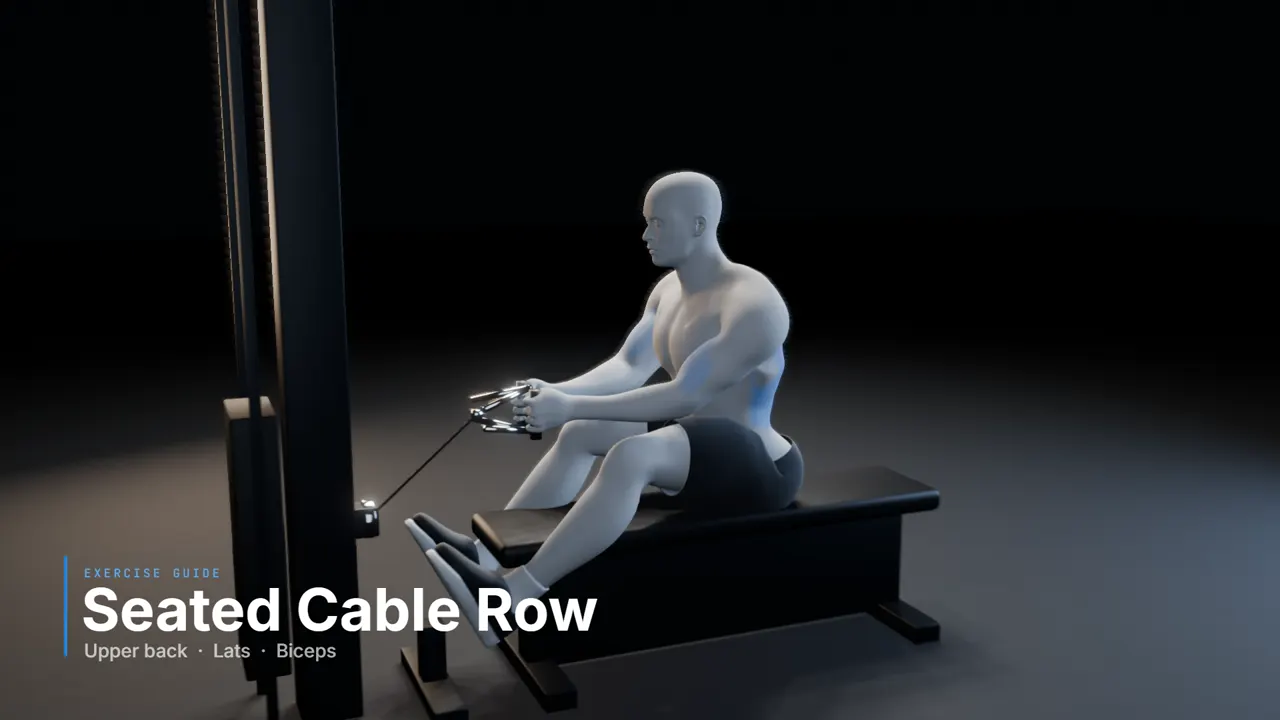
How to do a seated cable row
- Attach a V-handle (or a straight bar) to the low cable. Sit with your feet on the plate and your knees slightly bent.
- Take the handle and sit tall, chest up, with your arms reaching forward and your back straight.
- Pull the handle towards your lower ribs, driving your elbows back close to your sides.
- At the end, squeeze your shoulder blades together for a moment. Your torso stays upright.
- Let your arms straighten under control until they are long again, letting your shoulder blades move forward without rounding your back.
Cues that help
- "Sit tall": keep your chest up and your lower back in its natural curve the whole set.
- "Elbows back, close to your sides": the elbows lead, the hands just hold on.
- "Squeeze the shoulder blades": a short pause at the ribs makes the upper back do the work.
- "Reach long, back stays straight": the stretch comes from your shoulder blades, not from bending over.
Common mistakes
- Rocking the torso back and forth. A little movement is normal; swinging from your hips to move the weight means it is too heavy.
- Rounding your back as the handle goes forward. Keep your chest up and let only your arms and shoulder blades move.
- Pulling to your stomach or your neck. Aim for your lower ribs.
- Shrugging your shoulders up as you pull. Keep them down and back.
- Letting the weight snap back. Control the return; it is half of the rep.
Which handle should you use?
The V-handle (palms facing each other) is the classic choice: it keeps your elbows close to your body, which suits the lats, and most people pull it strongly.
A wider straight bar with an overhand grip lets your elbows travel out to the sides, which shifts more of the work to the upper back and rear shoulders. Rowing machines with chest pads take your lower back out of it entirely. All three train the same muscles; switching between them every few months adds variety.
Sets, reps and weight
- For muscle: 3 to 4 sets of 8 to 15 reps, stopping 1 to 3 reps short of failure.
- Rest 1.5 to 2 minutes between sets.
- Choose a weight you can pull with a still, upright torso and a clear squeeze at the ribs.
- Add a rep before adding weight, and add weight once you hit the top of your rep range on every set.
Variations and alternatives
- Wide-grip cable row: a long bar, overhand. More upper back and rear shoulders.
- Single-arm cable row: one side at a time, with a little torso rotation at the end.
- Chest-supported row machine: the same pull with a pad on your chest, so your lower back can rest.
- Barbell row: a heavier free-weight row, bent over, that also asks a lot of your lower back.
- Lat pulldown: the downward pull for the same muscles, a good partner in the same workout.
Tracking your rows
PushBeyond logs the weight and reps of each set and charts the history of the exercise, so you can see your rows get heavier. Its muscle map counts the seated cable row for your upper back and lats, with the biceps as a secondary muscle.