
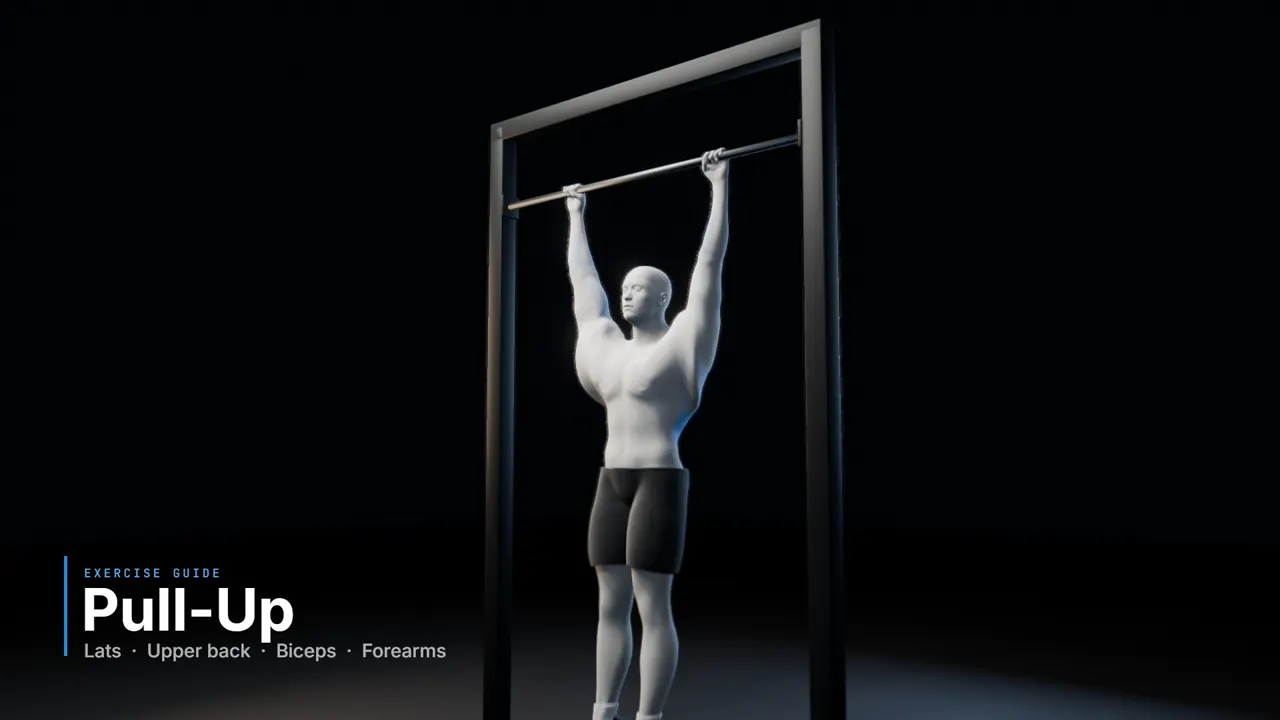
How to do a pull-up
- Grip the bar with your palms facing away, hands a little wider than shoulder width, thumbs wrapped around.
- Hang with your arms straight and your feet off the floor. Cross your ankles or keep your legs straight, slightly in front of you.
- Brace your stomach and squeeze your glutes so your body does not swing.
- Start the pull by drawing your shoulders down, away from your ears, without bending your elbows yet.
- Pull your elbows down and back towards your ribs until your chin is above the bar.
- Lower yourself under control until your arms are straight again. Pause briefly at the bottom before the next rep.
Cues that help
- "Elbows to your back pockets": it puts the work on your lats, rather than pulling with your hands.
- "Chest to the bar": aim your upper chest at the bar. It keeps you from craning your neck to get your chin over.
- "Shoulders down first": setting your shoulder blades at the start of each rep gives you a stronger, smoother pull.
- "Body like a plank": a tight stomach and glutes stop the swing that steals reps.
Common mistakes
- Half reps. Stopping before your arms are straight, or before your chin clears the bar, makes the number look better and the exercise easier. Count only full reps.
- Kipping or swinging by accident. Using your legs and hips to swing up is a different exercise; for strength, keep your body still.
- Dropping down fast. The lowering half builds strength too; take a second or two.
- Reaching your chin over the bar by craning your neck. Your chin is over, your body is not; pull higher instead.
- Shrugging your shoulders up to your ears at the bottom and top. Keep them pulled down.
Pull-up or chin-up?
The difference is your grip: palms facing away for a pull-up, facing you for a chin-up. Both are excellent back exercises.
A study of 25 young adults measured both. The lats were the most active muscle in both, working at a similar level. The chin-up made the biceps and chest work harder, while the pull-up made the lower trapezius (a muscle that pulls your shoulder blades down) work harder (Youdas et al., 2010).
The extra help from the biceps is why chin-ups often feel a little easier. Training both is a good way to cover your back and arms from two angles.
How to get your first pull-up
- Negatives: jump or step up so your chin is over the bar, then lower yourself as slowly as you can, aiming for 3 to 5 seconds. Do 3 to 5 of them.
- Band-assisted pull-ups: a resistance band looped over the bar and under your knee or foot takes some of your weight. Use thinner bands over time.
- Lat pulldown and rows: build the same muscles with a weight you can choose.
- Dead hangs: hang from the bar for as long as you can. It builds the grip a pull-up needs.
- Losing body fat helps too: a pull-up lifts your whole body weight.
Sets, reps and weight
- If you can do fewer than 5: 3 to 5 sets of as many clean reps as you can, plus negatives or band-assisted reps.
- If you can do 5 to 12: 3 to 4 sets, stopping 1 to 2 reps short of failure, resting 2 to 3 minutes.
- If you can do more than 12: add weight with a dip belt or a dumbbell between your feet, and work in the 5 to 10 rep range.
- Progress by adding a rep to your sets before adding weight.
Variations and alternatives
- Chin-up: palms facing you. More biceps, usually a few more reps.
- Neutral-grip pull-up: palms facing each other on parallel handles. Often the most comfortable for the shoulders.
- Lat pulldown: the same movement on a cable machine, with a weight you can set to match your strength.
- Weighted pull-up: extra weight on a belt once body-weight reps become easy.
- Inverted row: a horizontal pull under a bar. Easier, and a good way to build up to pull-ups.
Tracking your pull-ups
PushBeyond logs the reps of each set, and the extra weight if you add some, and charts the history of the exercise, so you can see your reps climb over the weeks. Its muscle map counts the pull-up for your lats and upper back, with biceps and forearms as secondary muscles.