
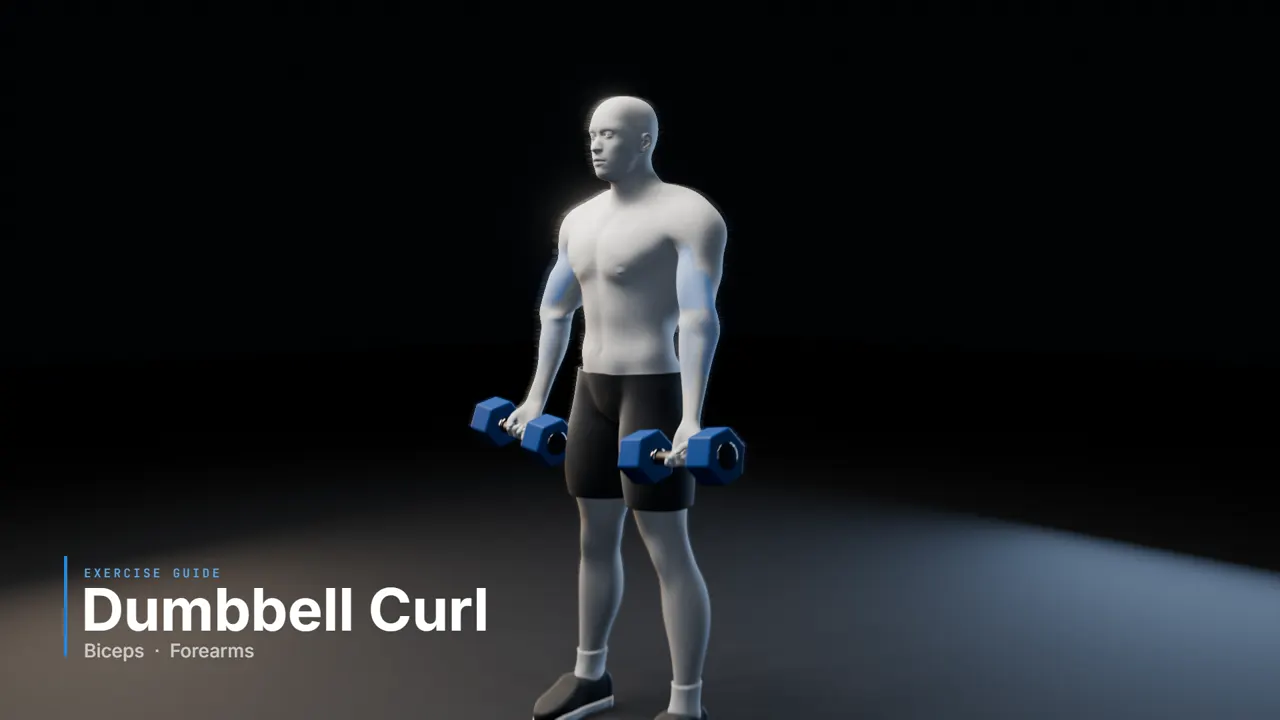
How to do a dumbbell curl
- Stand tall with a dumbbell in each hand, arms straight by your sides, palms facing forward or facing your thighs.
- Keep your elbows close to your sides, just in front of your hips.
- Bend your elbows to curl the dumbbells up, turning your palms up towards your shoulders if they started facing in.
- Squeeze at the top, when your forearms are nearly vertical, without letting your elbows travel far forward.
- Lower slowly, taking two to three seconds, until your arms are fully straight again.
Cues that help
- "Elbows pinned to your sides": they stay put; only your forearms move.
- "Pinky up at the top": turning the palm fully up uses the biceps’ second job.
- "Arms long at the bottom": straighten fully between reps for the full range.
- "Two seconds down": the lowering half grows the biceps too.
Common mistakes
- Swinging the weight up with your back and hips. If you have to lean back to finish, the dumbbells are too heavy.
- Elbows drifting forward and up. It turns the top of the curl into a shoulder raise and takes tension off the biceps.
- Not straightening the arms at the bottom. Half reps skip the stretched position.
- Dropping the weight on the way down.
- Bending your wrists to curl further. Keep them straight and in line with your forearms.
Dumbbell, barbell or cable?
Dumbbells let each arm work on its own and let your palms turn as you curl, which many people find comfortable on the wrists and elbows. A barbell fixes your hands in place and usually lets you lift a bit more in total. A cable keeps tension at the bottom, where a dumbbell is light.
All three build the biceps. Pick the one that feels best on your joints and progress it, or rotate them every few months for variety.
Sets, reps and weight
- For muscle: 2 to 4 sets of 8 to 15 reps, stopping 0 to 2 reps short of failure.
- Rest 1 to 1.5 minutes between sets. Alternating arms lets one rest while the other works.
- Pick dumbbells you can curl without leaning back. Your back and shoulders are not supposed to help.
- Progress by adding reps first: dumbbell jumps are large for the biceps.
Variations and alternatives
- Hammer curl: palms facing each other throughout. More brachialis and forearm.
- Incline dumbbell curl: sitting back on an incline bench, arms hanging behind you, for a bigger stretch.
- Preacher curl: upper arms resting on a pad, which removes all swinging.
- Barbell curl: both hands on one bar, usually a bit more weight.
- Cable curl: constant tension, easy to adjust.
Tracking your curls
PushBeyond logs the weight and reps of each set and charts the history of the exercise. Its muscle map counts the dumbbell curl for your biceps, with forearms as a secondary muscle.