
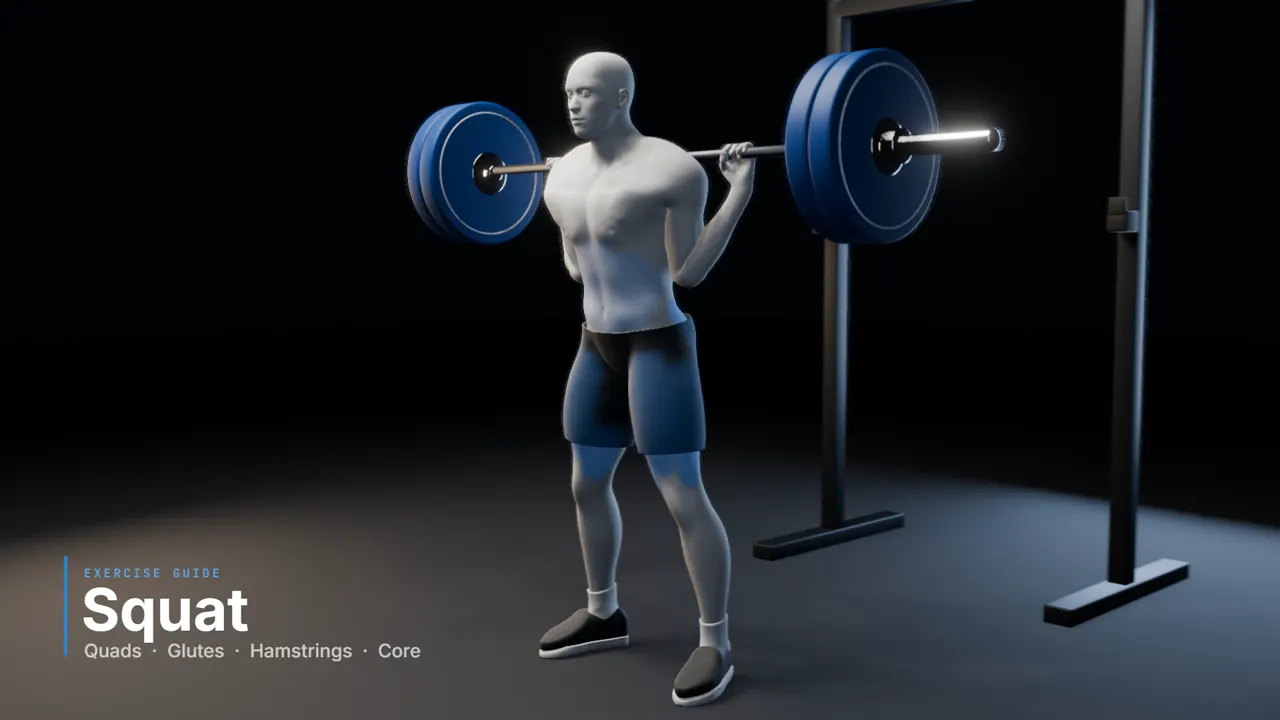
How to do a squat
- Set the bar in the rack at about armpit height, and the safety arms just below the depth you will squat to.
- Step under the bar and rest it on your upper back, on the muscle just below the bony point at the base of your neck (a "high bar"), or a few centimetres lower across the back of your shoulders (a "low bar"). Grip it just outside your shoulders.
- Stand up to lift it off the hooks, take two or three short steps back, and set your feet about shoulder width apart with your toes turned out slightly, usually 15 to 30 degrees.
- Take a big breath into your stomach and brace as if someone were about to poke you in the belly. Hold that breath on the way down.
- Bend at the hips and knees at the same time and sit straight down between your heels. Let your knees move forward and out over your toes.
- Go down until your hip crease is at least level with the top of your knees, or as deep as you can while keeping your back position and heels on the floor.
- Drive up through your whole foot, leading with your chest, until you stand tall. Breathe out at the top, reset, and repeat.
Cues that help
- "Knees out": push them in the direction of your toes, especially on the way up, rather than letting them cave in.
- "Spread the floor": imagine pushing your feet apart without moving them. It switches on your glutes and keeps your knees tracking.
- "Chest up": stops your hips shooting up first out of the bottom and turning the squat into a good morning.
- "Bar over mid-foot": the bar should travel in a straight vertical line over the middle of your foot. If it drifts forward, you are losing balance.
Common mistakes
- Knees caving in on the way up. A little movement happens under heavy loads; collapsing inward is a sign the weight is too heavy or your glutes are not engaged.
- Heels lifting off the floor. Your weight has moved onto your toes. Widen your stance slightly, turn your toes out more, or try lifting shoes or small plates under your heels.
- Cutting depth as the weight goes up. Half squats with more weight are not progress on the same lift. Keep your depth constant so your log compares like with like.
- Hips rising faster than your shoulders. The squat becomes a back exercise. Lead with your chest out of the bottom.
- Squatting heavy without the safety arms set. Failing a squat with nothing to catch the bar is the dangerous scenario. Set the safeties so you can sit down and leave the bar on them.
- Losing your breath and brace halfway. Breathe and brace before each rep, not once per set.
How deep to squat
Deeper squats build more muscle, at least down to a full squat. The quads grow either way; the glutes and inner thighs grow more when you go deep.
In a 2019 study, 17 men trained with full squats or half squats twice a week for 10 weeks. The front thigh grew by about the same amount in both groups (4.9% and 4.6%), but the glutes grew 6.7% with full squats against 2.2% with half squats, and the inner thighs 6.2% against 2.7% (Kubo et al., 2019). An earlier 12-week study also found that deep squats increased front thigh muscle size more than shallow ones (Bloomquist et al., 2013).
So squat as deep as you can with your heels down and your back position held. For most people that is at least parallel. If your lower back rounds at the bottom, stop just above that point.
Sets, reps and weight
The squat is a big, tiring lift, so it usually goes first in a leg session, when you are fresh.
- For strength: 3 to 5 sets of 3 to 6 reps, resting 3 to 5 minutes.
- For muscle: 3 to 4 sets of 6 to 12 reps, resting 2 to 3 minutes.
- Leave 1 to 3 reps in reserve on most sets; a grinding rep at the end of a set is where form breaks down.
- Add weight when you reach the top of your rep range on every set, usually in steps of 2.5 to 5kg.
Warm up with an empty bar and a few lighter sets before your working sets. The warm-up calculator below builds them from your working weight.
Variations and alternatives
- Front squat: the bar rests on the front of your shoulders, keeping your torso more upright and putting more work on your quads.
- Goblet squat: a dumbbell or kettlebell held at your chest. The easiest way to learn the movement and a good warm-up.
- Leg press: trains the quads and glutes with no bar on your back and no balance to hold, easy to push close to failure safely.
- Bulgarian split squat: one leg at a time with the back foot on a bench. Needs less weight for the same effort and shows up left-right differences.
- Box squat: sitting back to a box at a set depth. Useful for learning consistent depth.
Tracking your squat
PushBeyond logs each set's weight and reps, estimates your one-rep max from your best set with the Epley formula, and charts the history of the lift, so you can see whether your squat is still moving month to month. Its muscle map counts the squat for your quads and glutes, with hamstrings and core as secondary muscles.