
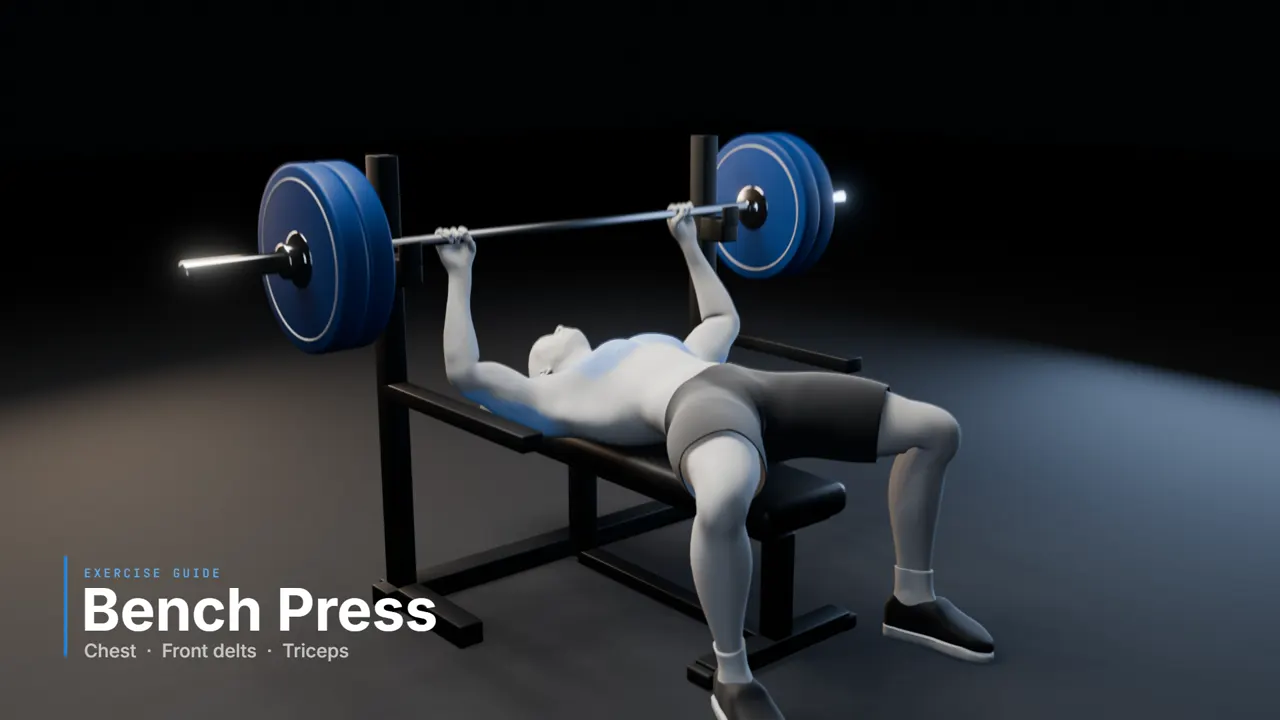
How to do a bench press
- Lie on the bench with your eyes under the bar. Set the safety arms or pins just below chest height, or have a spotter.
- Grip the bar a little wider than shoulder width, with your thumbs wrapped around it. Your forearms should be close to vertical when the bar touches your chest.
- Pull your shoulder blades back and down, as if tucking them into your back pockets. Keep them there for the whole set.
- Plant your feet flat on the floor. Your upper back and glutes stay on the bench; a slight natural arch in your lower back is fine.
- Unrack the bar and hold it over your shoulders with straight arms. Take a breath and brace your stomach.
- Lower the bar under control to your lower chest, around nipple height, with your elbows at roughly 45 to 70 degrees from your body rather than flared straight out.
- Press the bar up and slightly back, so it finishes over your shoulders again. Breathe out near the top, reset your breath, and repeat.
Cues that help
- "Bend the bar": try to snap it in half with your hands. It sets your upper back and keeps your elbows from flaring.
- "Chest to the bar": keep your chest up as the bar comes down, rather than letting it sink to you.
- "Push yourself away from the bar": thinking of driving your back into the bench often makes the press feel stronger.
- "Same spot every rep": touch the same point on your chest each time. A bar that wanders is a bar that is harder to press.
Common mistakes
- Bouncing the bar off your chest. It borrows momentum and makes the bottom of the lift, where you most need strength, the part you train least.
- Elbows flared straight out to the sides. It shifts strain onto the front of the shoulders; tuck them in somewhat.
- Lifting your hips off the bench to finish a rep. It turns the lift into a decline press and the rep no longer compares with last week.
- Loose shoulder blades. Without a set upper back the bar path drifts and the shoulders take more of the load.
- Benching heavy alone with no safety arms. Failing a rep with nothing to catch the bar is how bench press injuries happen. Use the safeties, a spotter, or stop a rep short of failure.
- A thumbless ("suicide") grip. The bar can roll out of your hands; wrap your thumbs.
How wide to grip
Slightly wider than shoulder width suits most people. Grip width changes how much you can lift more than it changes which muscles work.
In a 2021 study of 28 men, a narrow grip (about shoulder width) cost 6.6 to 8.4% of the load they could lift for six reps compared with a medium or wide grip, while chest muscle activity barely changed between grips. In the trained men, the triceps worked somewhat harder with a medium grip than with the widest one (Saeterbakken et al., 2021).
So pick the width where the bar feels strongest and your shoulders feel comfortable, then keep it the same every session. A close-grip bench press is a useful variation for the triceps, not a replacement.
Sets, reps and weight
The bench press works across a wide range of reps. Heavier sets build more strength on the lift itself; moderate sets build muscle about as well with less strain on the joints.
- For strength: 3 to 5 sets of 3 to 6 reps, resting 3 to 5 minutes.
- For muscle: 3 to 4 sets of 6 to 12 reps, resting 2 to 3 minutes.
- Leave 1 to 3 reps in reserve on most sets; go close to failure only with safeties set.
- Add weight when you hit the top of your rep range on every set, usually in steps of 1 to 2.5kg.
Warm up with a few lighter sets before the first heavy one. The warm-up calculator below builds those sets from your working weight.
Variations and alternatives
- Incline bench press: the bench at 30 to 45 degrees puts more work on the upper chest and the front of the shoulders.
- Dumbbell bench press: each arm works on its own, with a longer range of motion and no bar to get stuck under.
- Close-grip bench press: hands about shoulder width or a little narrower, more triceps.
- Push-up: the same movement pattern with no equipment. Loaded to a similar effort, push-ups with elastic bands built strength about as well as the bench press in a five-week study of 30 students (Calatayud et al., 2015).
- Machine chest press: a fixed path, easy to take close to failure safely when you train alone.
Tracking your bench press
Progress on the bench is slow enough that memory is a poor guide. PushBeyond logs each set's weight and reps, estimates your one-rep max from your best set with the Epley formula, and shows the history of the lift so you can see whether last month's numbers are still moving. Its muscle map counts the bench press for your chest, with triceps and shoulders as secondary muscles.